
EA 10000 Industrial Series: 60 kW DC Power Supplies and Loads in 6U
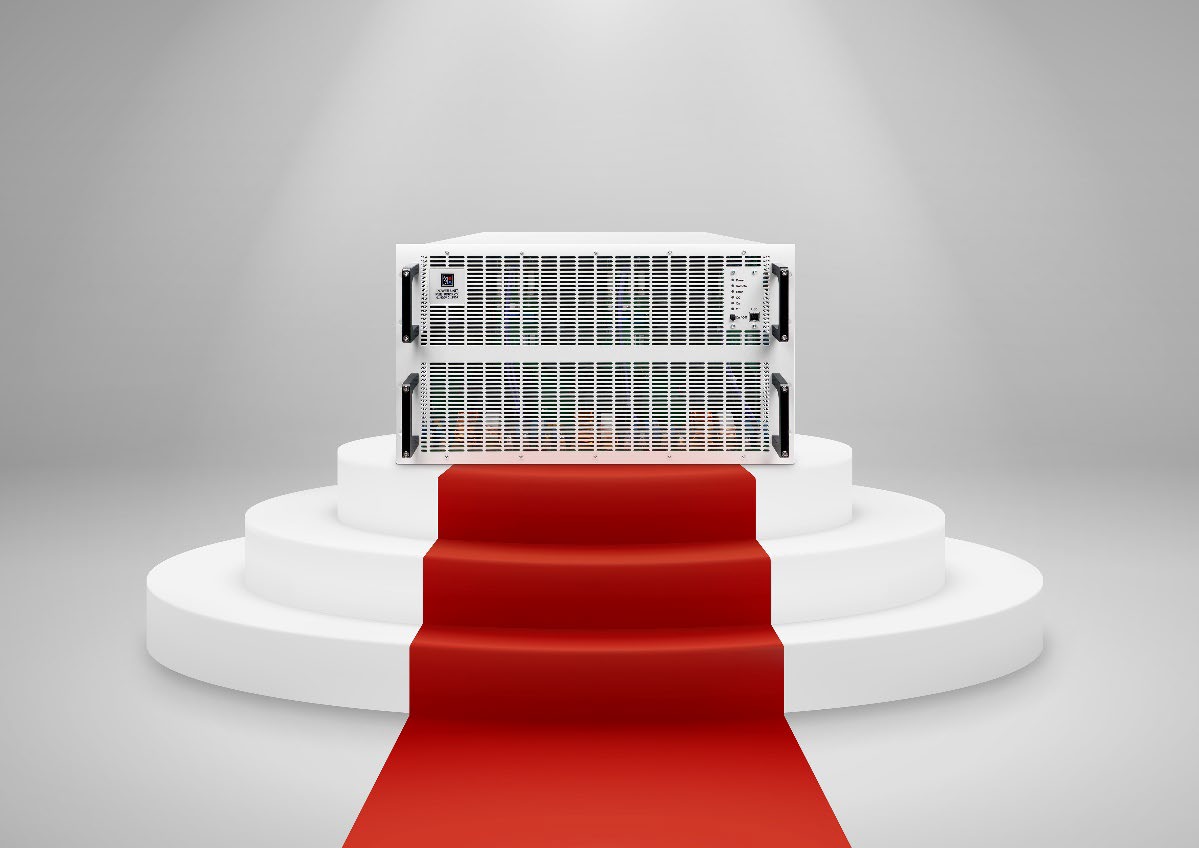
EA 10000 Industrial Series: 60 kW of DC power in 6U
When a test system needs hundreds of kilowatts, the limiting factor is rarely the DC source itself — it is how much of it you can fit in the rack, how many units you have to wire together, and how much of the energy you pull out of the DUT you have to throw away as heat. The EA Elektro-Automatik 10000 Industrial Series was built around exactly that problem.
The range strips out the front-panel display found on EA's benchtop instruments and puts the saved space and cost back into power: 60 kW in a 6U enclosure, or 30 kW in 4U. Everything is designed to be driven by a PC or PLC inside an automated test system or process control rig, rather than turned by hand.
Three instruments, one platform
The Industrial Series covers source, sink, and both:
- EA-PU 10000 — programmable DC power supplies, available in 60 kW (6U) and 30 kW (4U).
- EA-PUB 10000 — programmable bidirectional DC power supplies that source and sink on the same terminals, available in 60 kW (6U) and 30 kW (4U).
- EA-PUL 10000 — programmable regenerative electronic loads.
All three share the same firmware, the same programming interface and similar input and output characteristics. In practice that means test development done against one instrument transfers to the others, which matters a great deal when a control system has to drive a mixture of supplies and loads.
Voltage, current and model choice
- 60 kW models: maximum voltages from 360 V to 2000 V, maximum currents from 480 A down to 80 A — 21 models.
- 30 kW models: maximum voltages from 60 V to 2000 V, maximum currents from 1000 A down to 40 A — 29 models.
Fifty models across the series is a lot of choice, and it is worth spending time on the selection rather than defaulting to the highest rating — particularly because of how the outputs behave across their range.
True autoranging
Every 10000 series instrument has an autoranging output, or input in the case of the loads. A conventional rectangular-output supply only reaches full power at its maximum voltage and maximum current simultaneously. An autoranging instrument delivers higher voltage at lower currents and higher current at lower voltages, and can hold full power across a significant portion of its operating range.
For a test engineer the practical effect is straightforward: a single instrument covers a wider set of devices under test, so fewer instruments are needed to cover a product family.
Parallel operation up to 3.84 MW
Up to 64 units can be paralleled using the Master and Auxiliary bus (formerly the Master-Slave Bus), letting one instrument control the whole system — up to 3.84 MW. The system can consist of any combination of 10000 series models, and a galvanically isolated Share-Bus interface in each unit makes sure the load is shared safely so that no instrument in the system is overloaded.
Energy recovery on the bidirectional models
The PUB bidirectional supplies and PUL regenerative loads return up to 96% of absorbed power back to the grid at a power factor of 0.99. On a battery pack cycling rig or an inverter test bench running continuously, that is the difference between paying twice — once for the energy, once for the air conditioning to remove it — and paying once.
All models include overcurrent, overvoltage, overpower and overtemperature protection.
Optional built-in function generator
The PU, PUB and PUL are all available with an on-board full function generator as a software option. It creates complex signals riding on a DC bias and simulates the characteristics of devices such as solar cells, batteries and fuel cells. Special functions cover:
- Maximum power point tracking (MPPT)
- EN 50530 solar panel inverter testing
- LV123, LV124 and LV148 based test sequences for automotive components and systems
Having these on board removes the need for external waveform generation instrumentation wired into the DC path — one less interconnection to get right, and one less item to calibrate.
Control and interfacing
The 10000 series is programmed over SCPI or ModBus and works equally well in a PC-controlled test system or a PLC-controlled industrial process. The instruments have an extensive set of galvanically isolated interfaces.
- Standard: Ethernet, USB, analogue
- Optional: CAN, CANopen, RS-232, Profibus, ModBus, Profinet, EtherCat
Typical applications
- Electric vehicle battery pack testing
- Powering furnaces in semiconductor wafer fabrication facilities
- Electrochemical electrolysis processing
- Solar inverter testing
Is the Industrial Series the right choice?
The absence of a front panel is a deliberate trade. If an instrument will spend its life in a rack under software control, the display is dead weight and dead cost. If your engineers need to set voltage and current by hand at the bench, EA's PSI, PSB and PSE ranges are the better fit.
The other question worth asking early is how the system will grow. Because the 10000 series parallels up to 64 units on a common bus, it is usually cheaper to specify a modest system now with headroom to add units later than to buy peak capacity up front.
Talk to us about specifying a system
Caltest Instruments supplies the full EA Elektro-Automatik range in the UK and Ireland, and we build and integrate complete AC and DC test systems around it. If you are sizing a high-power DC rig — or working out whether 30 kW in 4U or 60 kW in 6U is the sensible starting point — get in touch and we will work through the model selection with you.
Instruments supplied through us are backed by our UK service and calibration facility, so the same team that specifies the system can keep it in tolerance afterwards.
EA Elektro-Automatik's original press release for the Industrial Series is attached below.


