Caltest Now Supplies Yokogawa Power Analysers: How to Choose the Right One
Caltest Instruments is now a UK supplier of Yokogawa Test & Measurement power analysers, from the bench-friendly WT300E to the ±0.03% WT5000: the class of instrument that inverter, motor and converter development increasingly depends on. This guide explains what each Yokogawa power analyser in the range covers, when precision class genuinely matters, and what the change means if you currently run a Newtons4th (N4L) analyser.
Key takeaways:
- Caltest now supplies and supports the Yokogawa power analyser range across the UK — WT300E, WT500, WT1800R, WT5000 and PX8000 — with UKAS-accredited calibration available to keep results traceable.
- Accuracy class decides what you can resolve: measuring a 98.5%-efficient converter with ±0.1%-class instruments can put roughly ±0.2 percentage points of uncertainty on the result, more than a tenth of the loss you're trying to measure.
- Newtons4th (N4L) has concluded production. Existing PPA instruments keep working and N4L support continues for now, but the Yokogawa WT series is the closest like-for-like migration path — and Caltest can typically calibrate N4L units in the meantime.
What's changed at Caltest?
Caltest Instruments has added the Yokogawa Test & Measurement power analyser range to its UK offering, alongside its existing general-purpose power measurement lines. The range is live on our power analysers page, with supply, support and calibration handled from our laboratory in Petersfield, Hampshire.
The reasoning is straightforward. General-purpose bench and production power measurement was already well covered. What our range couldn't reach was the precision end — the accuracy class and channel count that inverter, motor and converter development increasingly demands. Yokogawa's instruments are widely regarded as the reference in that class, and the WT5000 in particular does what nothing else in our range could. If you're weighing up where to buy, our guide to choosing a power analyser supplier you can rely on covers what to look for beyond the instrument itself.
When does ±0.03% accuracy actually matter?
Accuracy class matters whenever the quantity you care about is small compared with the quantities you measure — and in efficiency work, it almost always is.
Say you're measuring a converter at 98.5% efficiency. The number you're actually trying to resolve is the 1.5% of loss. Measure input and output power with ±0.1%-class instruments and, worst case, your efficiency figure carries around ±0.2 percentage points of uncertainty. More than a tenth of the loss you're chasing disappears into the instrument. At ±0.03% basic power accuracy, as on the WT5000, that band shrinks to roughly ±0.06 points.
The practical consequence: when the design change you're validating is worth 0.2% efficiency, the analyser decides whether you can see it at all. Specify too low and the losses you're measuring can be smaller than the measurement uncertainty; specify too high and you pay for precision the application doesn't use. The right instrument is the one matched to the measurement.
The Yokogawa power analyser range at a glance
Five instruments cover the range from standby-power verification to transient capture:
- Standby power and production-line testing — WT300E: economy analysers supporting IEC 62301 / EN 50564 standby-power measurement, with high accuracy across a wide dynamic range.
- General R&D and bench efficiency work — WT500: mid-range measurement of voltage, current, power and harmonics, with up to three input elements.
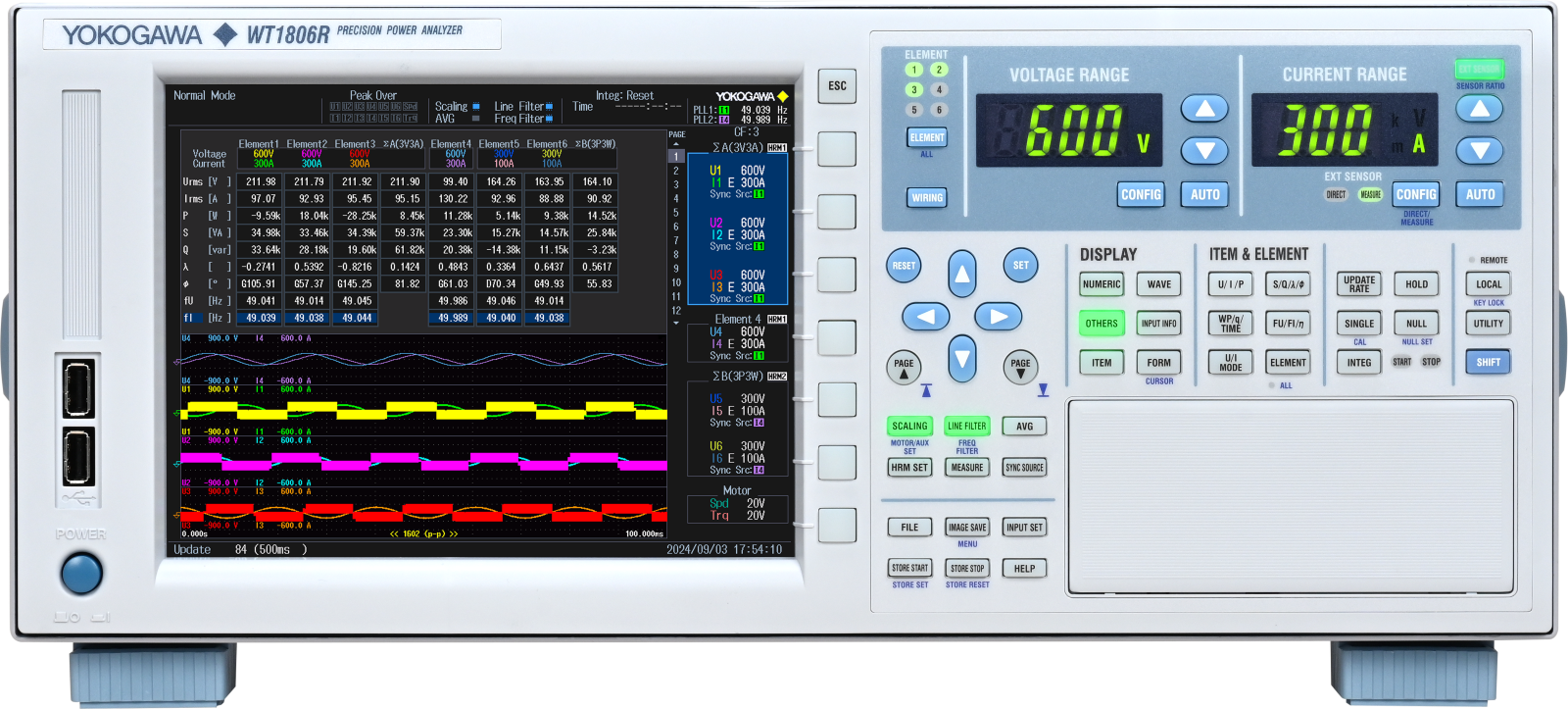
- Input/output efficiency on three-phase systems — WT1800R: up to six input elements, ±0.05% power accuracy and harmonic analysis to the 500th order, in a rack-ready format for automated test.
- Highest-precision conversion-efficiency work — WT5000: ±0.03% basic power accuracy and up to seven reconfigurable input elements for inverter, motor and power-conversion testing.
- Transient and start-up events — PX8000: precision power measurement combined with oscilloscope-style waveform capture, for events conventional analysers aren't designed to see.
Full specifications and datasheets are on each product page linked above, and UKAS-accredited calibration is available for the life of the instrument. For background reading on the measurement types behind efficiency and power quality work, Yokogawa's application note Choosing the Right Instrument for Power Quality and Energy Efficiency is a useful desk reference.
Using a Newtons4th (N4L) analyser? There's a realistic migration path
Newtons4th announced it has concluded production: "After many years manufacturing precision test and measurement instruments, Newtons4th has concluded production." N4L was a respected British instrument maker, and its PPA analysers earned their place on many benches.
The company states that support for existing customers is continuing, including calibration and technical assistance for current units. That buys time — but every future fault becomes a question of parts availability, and instruments carrying ongoing programmes (accredited test schedules, production lines, long-running R&D) deserve a transition plan before a fault makes the decision for you.
The Yokogawa WT series is the closest like-for-like class to the PPA range. As typical starting points:
- Compact bench and single-phase work (PPA500/1500 class) → WT300E or WT500
- Multi-phase drive and inverter development (PPA3500/4500 class) → WT1800R
- Highest-precision efficiency work (PPA5500 class) → WT5000
- Transient and start-up capture → PX8000
Model-for-model mapping is never exact; the right answer depends on your channel count, current ranges and the standards you test to.
In the meantime, calibration needn't stop: we can typically still calibrate N4L analysers in our own laboratory — not always across the manufacturer's full specification, but often enough to keep a healthy instrument traceable and in service. Tell us your model and the measurement points you rely on, and we'll confirm what we can cover.
Not sure where your application sits?
Tell us what you're measuring — power levels, phases and the figures you need to stand behind — and we'll help you match the analyser to the measurement, whether that's a WT5000 or something far simpler.
Speak to an engineer → sales@caltest.co.uk | +44 (0)1483 302 700
Frequently asked questions
Who supplies Yokogawa power analysers in the UK?
Caltest Instruments Ltd, based in Petersfield, Hampshire, supplies and supports the Yokogawa Test & Measurement power analyser range across the UK, with UKAS-accredited calibration available. The full range is listed on the Caltest power analysers page.
What is the most accurate Yokogawa power analyser?
The Yokogawa WT5000 is the precision flagship of the range, with ±0.03% basic power accuracy and up to seven reconfigurable input elements. It's designed for the highest-precision conversion-efficiency work on inverters, motors and power-conversion systems.
What can I replace a Newtons4th (N4L) power analyser with?
The Yokogawa WT series is the closest like-for-like class to the N4L PPA range. Typical starting points: WT300E or WT500 for compact bench work (PPA500/1500 class), WT1800R for multi-phase drive development (PPA3500/4500 class), WT5000 for highest-precision efficiency work (PPA5500 class), and PX8000 for transient capture. The exact match depends on channel count, current ranges and the standards you test to.
Can N4L power analysers still be calibrated?
Yes. N4L states that it continues to support existing customers, including ongoing calibration services. Caltest can also calibrate N4L analysers in its Petersfield laboratory — coverage varies by model, and we don't always match the manufacturer's full specification, but core measurement points can usually be kept traceable. Contact us with your model and the measurement points you rely on, and we'll confirm what we can cover.
Do I need a ±0.03% power analyser?
Only if the quantity you're resolving demands it. As a rule of thumb: if the losses or design margins you're measuring are within an order of magnitude of your instrument's uncertainty, you need a higher accuracy class. For standby power, production testing and general bench work, the WT300E and WT500 are usually the better-matched — and better-value — choice.