

Products


Frequently Asked Questions
What's the difference between an AC Power Supply and a Power Source?
An AC Power Source, also known as an AC Power Supply, is a specialized test instrument that delivers controlled alternating current (AC) voltage with adjustable parameters such as voltage level, frequency, and waveform shape. It is designed to provide precise and stable AC power for testing, simulating, and validating electrical devices and systems under various operating conditions. AC power supplies are commonly used in laboratories and production environments where programmable and repeatable AC power is required. The term AC Power Sources is sometimes used to indicate more advanced capabilities than supplying a source.
What is a programmable AC power source used for?
A programmable AC power source generates clean, adjustable AC power with independent control over voltage, frequency and waveform. It is a test instrument, not a mains adapter or a variac. Engineers use one whenever the supply itself is part of the test: qualifying avionics to RTCA/DO-160 and MIL-STD-704 at 400Hz, checking that an export appliance works on 100V/50Hz, 120V/60Hz and 230V/50Hz from a single bench, validating UPS and EV charger behaviour during brownouts and interruptions, running IEC 61000-4-11 voltage dip and interruption tests, and simulating inrush conditions during production testing.
Should I choose a linear or a switch-mode AC power source?
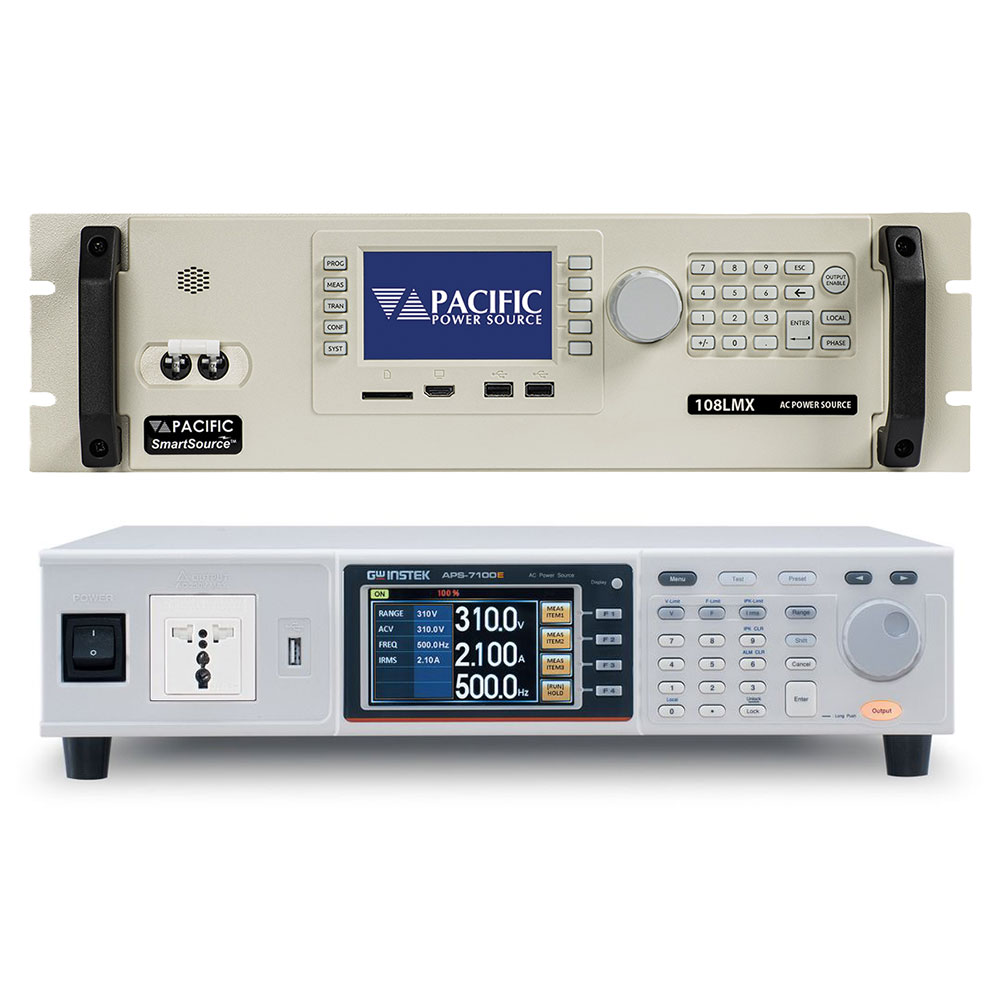
It comes down to distortion versus power density. Linear models such as the Pacific Power Source LMX Series and GW Instek APS-7000 Series use a linear amplifier stage, giving very low output distortion - below 0.1% THD up to 450Hz on the LMX - which matters for metrology, low-noise measurement and any test where the source must not contribute error. Switch-mode models such as the LSX and ADF Series use PWM amplifier technology, which delivers substantially more power in the same rack space - the ADF fits 15kVA into 4U - and typically adds features like programmable output impedance and transient sequencing. If your priority is signal purity, go linear. If it is power in a small footprint, go switch-mode. Our applications team can advise on which suits your test.
What power ratings and output voltages are available?
Our AC power source range starts at 500VA with the bench-top GW Instek APS-7000E and runs through 6kVA across the APS-7000, LSX and LMX Series to 180kVA on the Pacific Power Source ADF Series. The LMX parallels to 30kVA, and the ADF packs 15kVA into 4U of rack space. Output voltage reaches 300Vac direct-coupled on the LMX and 310Vrms on the APS-7000 Series, with transformer options extending output to 600Vac on the Pacific Power Source models and an optional module taking the APS-7000 to 600Vrms. If you need more than this, our AC+DC and regenerative ranges scale considerably further - contact us with your voltage, current and power requirements and we will match a unit to them.
Do I need a single-phase or three-phase AC power source?
Match the source to the equipment under test. Single-phase covers most consumer products, appliances, medical devices and bench-level R&D. Three-phase is needed for industrial equipment, motor drives, larger UPS systems and three-phase EV charging equipment. Both the Pacific Power Source LSX and LMX Series are available in single-phase, split-phase and three-phase configurations, and the three-phase models can be reconfigured to run as single-phase - useful if your test requirements vary. Three-phase units also allow programmable phase angles from 0 to 360 degrees for phase imbalance and unbalanced-load testing.
Do you support different frequency standards?
Yes. Our power sources cover the standard global frequencies of 50Hz and 60Hz, 400Hz for aerospace and defence work, and extended ranges up to 5000Hz on selected models such as the Pacific Power Source LMX Series. The LSX Series covers 15-1200Hz and the GW Instek APS-7000 Series covers 45-500Hz, extendable to 999.9Hz with an optional module. This makes the range suitable for global market compliance testing as well as specialised avionics applications.
Can an AC power source simulate mains disturbances like sags, dips and brownouts?
Yes. That is one of the main reasons to own one. Programmable AC sources can produce voltage sags, dips, interruptions, surges, brownouts, frequency shifts and phase-angle changes on demand, and can sequence them into automated test profiles. The LSX Series supports LIST, PULSE and STEP transient programming with capacity for over 200 arbitrary waveforms, so you can replay a real-world disturbance repeatedly and identically. This makes the range well suited to pre-compliance dip and interruption work and to any development testing where a product must ride through poor supply conditions. For full IEC 61000-4-11 compliance testing, the source is normally paired with an electronic power transfer switch such as the Pacific Power Source EPTS Series, which achieves the sub-5-microsecond voltage transitions the standard requires.
Which test standards can I work to with an AC power source?
The range supports avionics and defence qualification to RTCA/DO-160 and MIL-STD-704, pre-compliance testing for IEC 61000-4-11 voltage dips and short interruptions, and general product qualification against regional mains conditions for CE and international market approval. Two things need more than a source on its own: full IEC 61000-4-11 and -4-34 compliance normally requires an electronic power transfer switch such as the EPTS Series, and IEC 61000-3-2 harmonics and IEC 61000-3-3 flicker emissions testing calls for a dedicated harmonics and flicker test system. Tell us which standard you are working to and we will specify the right configuration.
Can I rent an AC power source instead of buying one?
Yes. Every AC power source in our range is available for short-term and long-term rental as well as purchase. Rental makes sense for one-off compliance campaigns, project work with a fixed end date, covering a peak in test capacity, or trying an instrument before committing to buy. Rental units are supplied calibrated and ready to use, with applications support included. Contact our team with your specification and test duration for a quote.