

Products



Frequently Asked Questions
What is a grid emulator and how is it different from an AC power source?
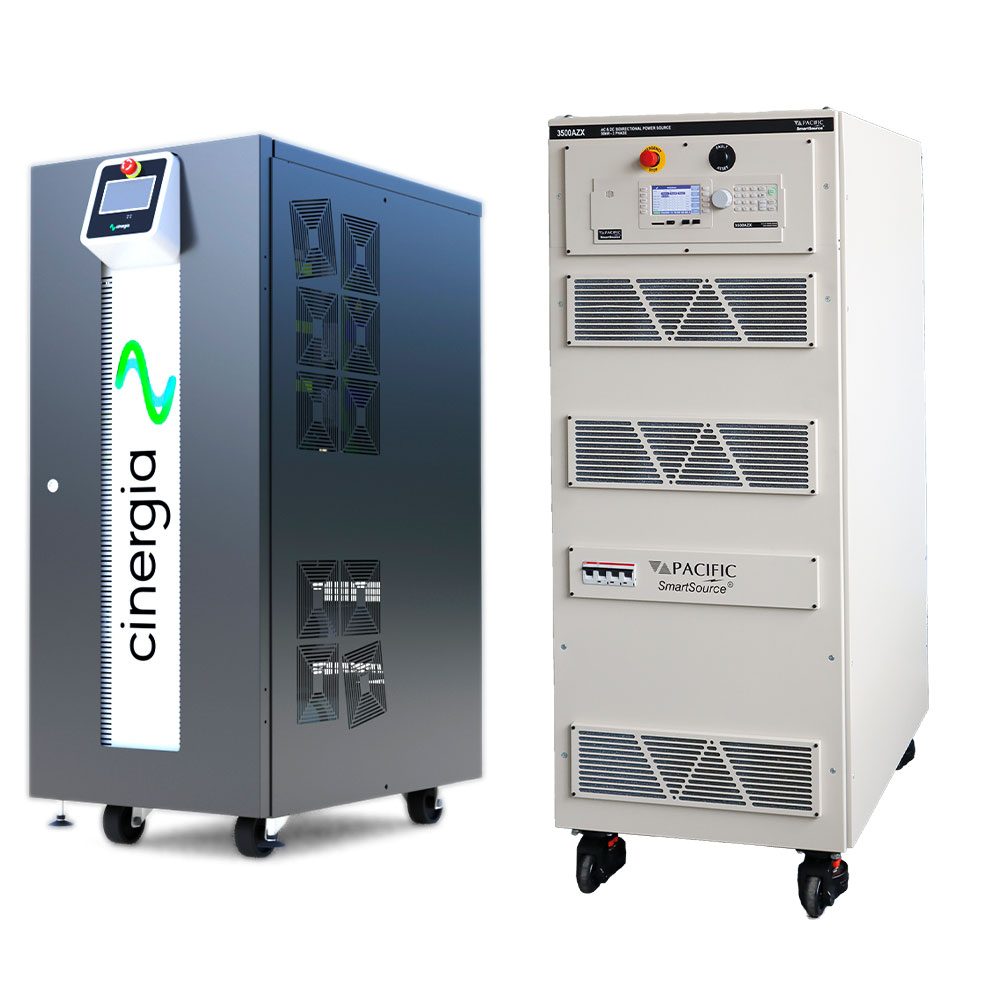
Every grid emulator is an AC power source, but not every AC power source is a grid emulator. The difference is what it can absorb. A grid emulator is built to sink power as well as supply it, because a grid-tied inverter under test is exporting energy into it. It also carries the fault and disturbance library the standards demand: programmable voltage sags and swells, frequency ramps, phase jumps, harmonic injection and islanding conditions, applied with precise timing. If you are powering a device, an AC source is enough. If you are testing something that pushes power back and must be certified for grid connection, you need a regenerative four-quadrant emulator.
What is anti-islanding testing and which standard applies?
Islanding is when a grid-tied inverter keeps energising a section of network after the utility supply has been lost. It is dangerous, because line workers may believe a circuit is dead when it is not, and it can damage equipment when the supply returns out of phase. Anti-islanding testing proves the inverter detects loss of mains and disconnects within the required time. IEC 62116 defines the standard test procedure, and the emulator must be able to establish a balanced resonant load condition where real and reactive power match the inverter output, which is the hardest case to detect. In Great Britain, grid connection also falls under ENA Engineering Recommendation G98 and G99 depending on scale, and EN 50549 applies across Europe.
What is low and high voltage ride-through testing?
Ride-through testing checks that an inverter stays connected and keeps operating through a grid disturbance rather than tripping off. Low voltage ride-through (LVRT) applies a voltage dip of defined depth and duration and confirms the inverter remains synchronised and resumes normal output cleanly. High voltage ride-through (HVRT) does the same for over-voltage events. The requirement exists because if every distributed generator disconnected during a fault, the resulting loss of generation would make the disturbance considerably worse. Testing requires an emulator that can hold a precise voltage profile against an active inverter without the inverter's own output distorting the test.
Why does a grid emulator need to be regenerative and four-quadrant?
Four-quadrant means the unit can source and sink current at either polarity, which is what allows it to handle real and reactive power flowing in both directions, exactly as a real network does. Without it you cannot properly test an exporting inverter, a bidirectional charger or a motor drive returning energy under braking. Regenerative describes what happens to the absorbed energy: instead of being dissipated as heat, it is returned to your facility supply at high efficiency. On a multi-hundred-kilowatt inverter test running for days, that is the difference between a manageable electricity bill with normal ventilation and a very large one plus a serious cooling problem.
What is power hardware-in-the-loop (PHIL) testing?
Power hardware-in-the-loop connects a real piece of equipment to a simulated electrical network running in real time. A model of the grid, microgrid or vehicle system computes what conditions the device should see, the grid emulator applies them physically, and measurements feed back into the model to close the loop. It lets you test real hardware against network scenarios that would be impossible, unsafe or prohibitively expensive to create for real, including faults, extreme loading and unusual topologies. It needs an emulator with high bandwidth and low latency so the physical response tracks the simulation closely enough to remain stable and meaningful.
Can I rent a grid emulator?
Yes. Grid emulators and anti-islanding test systems are available for short-term and long-term rental as well as purchase. Rental is common for certification campaigns with a defined end date, where the equipment is needed intensively for a few weeks and then not again until the next product. It is also a practical way to prove a test approach works before committing to a capital purchase. Rental units are supplied with applications support included. Contact us with your inverter rating, the standards you are testing to and your timescale for a quote.