



Products


Frequently Asked Questions
What makes an industrial DC power supply different from a bench supply?
Scale and architecture, not just a bigger number on the front panel. A bench supply runs from single-phase mains, delivers tens or hundreds of watts, and is set by hand. An industrial supply takes a three-phase input, delivers tens to hundreds of kilowatts from a rack chassis, is controlled entirely over an interface as part of an automated test system, and is built to run at full load continuously. It also scales: units parallel together to behave as one much larger supply, and bidirectional models return absorbed energy to the mains instead of dissipating it as heat. Our range covers 5kW to 500kW.
What does autoranging mean on a DC power supply, and why does it matter?
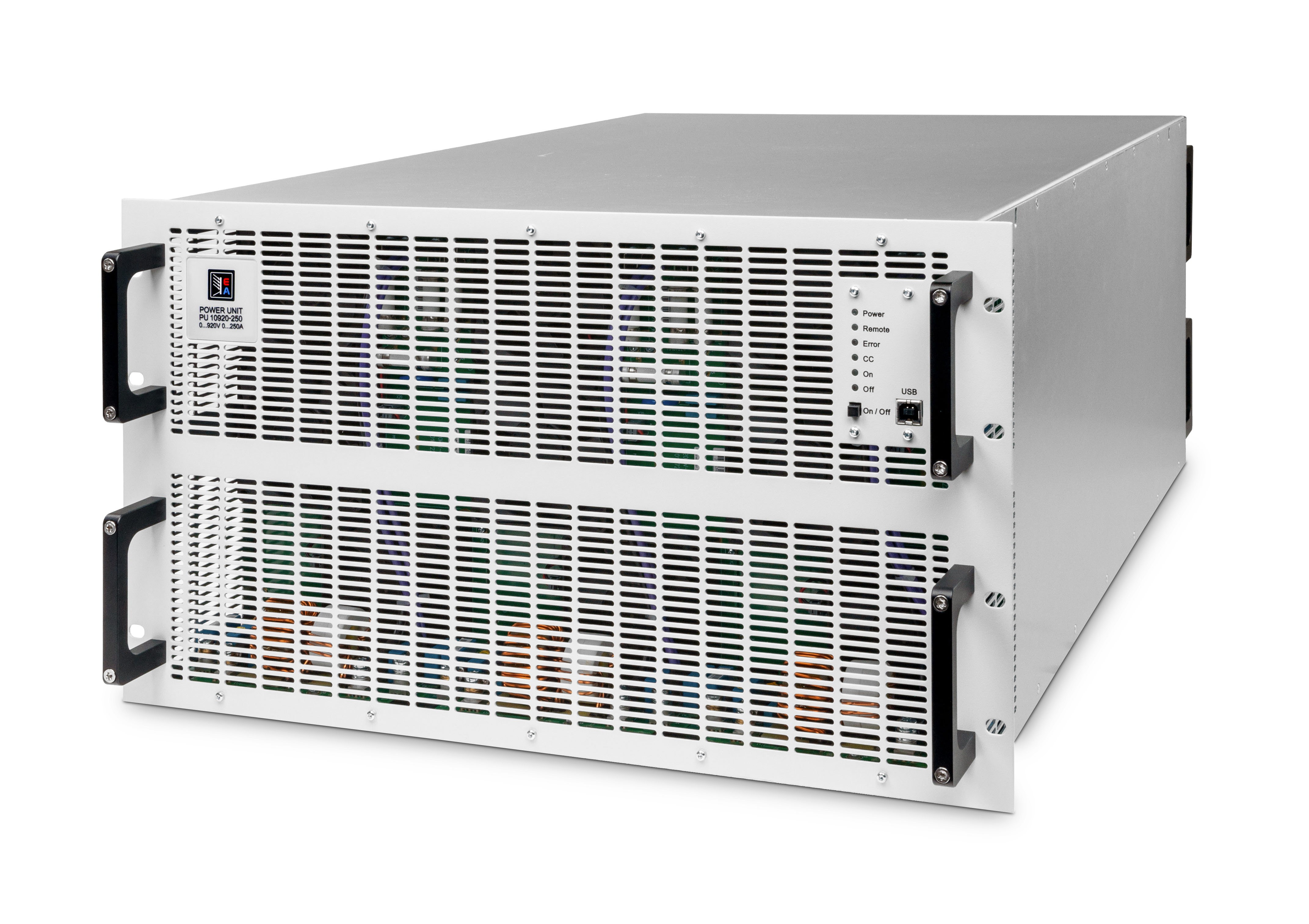
A conventional supply is rated at a fixed maximum voltage and a fixed maximum current, and you only get full power at the single point where both are at maximum. An autoranging supply trades voltage against current across a curve, so the same unit delivers its full rated power at high voltage and low current, or low voltage and high current. The Elektro-Automatik PU 10000 shows what that means in practice: a single 4U chassis covers output ranges from 0-60V right through to 0-2000V, with currents up to 1000A, all from the same 30kW unit. Where a conventional approach would need several supplies to cover that envelope, one autoranging unit does it from a single rack slot.
What is a bidirectional DC power supply and when do I need one?
A bidirectional supply can both source and sink current through the same output. Sourcing works like any power supply; sinking means it acts as an electronic load, absorbing energy from the device under test. On regenerative models that absorbed energy is returned to the mains supply rather than dissipated as heat, at up to 96% efficiency on the Elektro-Automatik PUB 10000. You need one whenever the device under test can push energy back: battery packs and chargers, motor drives with regenerative braking, bidirectional converters and grid-tied inverters. It also halves the equipment count, since one unit replaces a separate supply and load. The PUB 10000 covers this at 30kW in 4U and 60kW in 6U, and the Pacific Power Source AZX Series adds full four-quadrant operation across both AC and DC.
How much power do I need, and how far can these systems scale?
Size on the worst case your device under test will draw, then add headroom for inrush and transient peaks, which can be several times the steady-state figure. Our industrial range starts at 5kW with the Zenone AL3000 and extends to 500kW in a single system. The Elektro-Automatik PU and PUB 10000 sit in between at 30kW in a 4U chassis and 60kW in 6U, with output voltages to 2000V and currents to 1000A. Where you need more, up to 64 units can be paralleled under a single control interface, reaching 3.84MW. That means you can specify for today's requirement and expand later rather than replacing the system. Tell us your voltage, current and power profile and we will size it properly.
What remote interfaces are available for automated testing?
Industrial supplies are designed to be driven by a test system rather than a front panel. Ethernet and USB are standard across the range, with CAN, CANopen, Profibus, Profinet, EtherCAT, Modbus TCP and EtherNet/IP available through plug-in interface modules depending on model and manufacturer. Analogue programming inputs are also provided on most industrial units where a simple 0-10V control signal suits the installation better. Command sets are generally SCPI-based, which makes integration with LabVIEW, Python and existing test frameworks straightforward. Tell us which protocol your controller speaks and we will confirm which models support it natively rather than needing an adapter.
Can a DC power supply emulate a battery or a solar array?
Yes, and at this power level it is one of the main reasons to buy one. Battery emulation makes the supply behave like a cell or pack with a defined state of charge, internal resistance and discharge curve, which lets you test a BMS, charger or inverter repeatably without the cost, safety risk and long cycle times of a real pack. Solar array simulation reproduces a photovoltaic I-V curve so you can test maximum power point tracking on an inverter across changing irradiance and temperature. Fuel cell simulation works the same way. All three functions are built into the Elektro-Automatik PU and PUB 10000 ranges. Bidirectional models such as the PUB are required for battery emulation where the device under test needs to push current back.


