
Hipot, ground bond, insulation resistance or leakage current: which electrical safety tests does your product need?
Short answer. Hipot, ground bond, insulation resistance and leakage current are four tests that together make one safety case: insulation that holds under stress, an earth path that carries a fault, and currents that stay within safe limits. Most product safety standards ask for more than one of them. Your product category and the standard it falls under decide which tests apply, at what level and for how long.
What does a hipot test prove?
A hipot test, also called a dielectric withstand or electric strength test, applies a voltage well above the product's working voltage between its live parts and its accessible conductive parts. It proves that the insulation can withstand that stress without breaking down. The tester watches the current that flows and fails the product if it passes a set limit or if an arc or flashover occurs.
The test can use AC or DC:
- AC hipot stresses the insulation in both polarities, much as the mains does in service. The tester also has to supply the current that charges the product's capacitance, which can be significant.
- DC hipot draws very little current once the product has charged, so it's often used for capacitive products such as long cables, motors, or equipment with large EMC filter capacitors. The product needs to be discharged safely after the test.
Where a standard permits a DC test in place of an AC one, the DC voltage is commonly set at about 1.414 times the AC rms value, which is the AC peak. Check the standard before you substitute one for the other.
What does a ground bond test check?
A ground bond test checks that the protective earth path, from the earth pin of the mains plug to every accessible metal part, can carry a fault current. The tester passes a high current through that path and measures its resistance, usually in milliohms.
The high current matters. A loose screw, a crimp holding by a few strands or a painted joint can pass a low-current continuity check and still fail when it has to carry a fault. The test current is set by the standard and is often linked to the rating of the product's protective device. Dedicated testers such as the GW Instek GCT-9040 (3 to 40 A) and the SCI 260 Series (40 A or 60 A) cover most ranges.
Four-wire (Kelvin) measurement is worth having. Separate sense leads take the resistance of the test leads out of the reading, which matters when the limit is a fraction of an ohm.
Insulation resistance: when a megohm reading tells you more than pass/fail
An insulation resistance test applies a DC voltage and reports the resistance of the insulation, usually in megohms or gigohms. Where a hipot test gives a pass or a fail, an insulation resistance reading gives a number you can trend.
That makes it useful for spotting moisture, contamination or ageing before they cause a failure, and for comparing units across a batch. Some standards, such as BS EN 60204-1 for machinery, ask for it directly. Elsewhere it's often run before a hipot test as a quick check.
Leakage current: touch current and protective conductor current
Leakage current tests measure the current that flows while the product is powered and working. There are two main measurements:
- Touch current: the current that would flow through a person touching an accessible part. It's measured through a network that represents the human body, described in IEC 60990.
- Protective conductor current: the current that flows in the protective earth conductor in normal use.
Tests are usually repeated under normal conditions and under single-fault conditions, such as an open neutral or an open earth. Medical electrical equipment has some of the tightest limits, because it can be connected to a patient. A leakage current tester such as the GW Instek GLC-10000 powers the equipment under test through its own outlets, so it can measure while the product runs.
Which standards ask for which tests?
The list below shows the main safety tests each standard covers. It isn't a complete list or a compliance ruling: a standard can call for tests that aren't named here, and which tests apply depends on your product and the clauses it falls under. Check the edition you're working to and the requirements of the market you're selling into.
- BS EN 61010-1 (electrical equipment for measurement, control and laboratory use): dielectric strength, protective bonding and limits on accessible currents. Annex F describes routine tests for production. Our EN 61010 guide covers the standard in more detail.
- BS EN 60204-1 (electrical equipment of machines): continuity of the protective bonding circuit, insulation resistance and voltage tests, carried out on the machine itself. See our EN 60204-1 article.
- IEC 60335-1 (household and similar electrical appliances): leakage current and electric strength, including after humidity treatment, and the resistance of earthing connections. Annex A describes routine tests.
- IEC 60601-1 (medical electrical equipment): dielectric strength, protective earth impedance and leakage currents, including patient leakage current. IEC 62353 covers recurrent testing and testing after repair, including protective earth resistance and leakage current.
- IEC 62368-1 (audio/video, information and communication technology equipment): electric strength, protective bonding resistance, and touch current and protective conductor current measured to IEC 60990. IEC 62368-1 replaced IEC 60950-1 and IEC 60065.
Check the edition you're working to. In the EU, the edition of EN 62368-1 cited under the Low Voltage Directive is still EN 62368-1:2014, and the same edition is designated in Great Britain. In the EU, EN 60601-1 (with amendment A13:2024) was cited under the Medical Devices Regulation in June 2026, which may prompt manufacturers to review their safety test evidence.
Type test or routine production test: what changes?
A type test proves the design. It's done on samples, often by a test house or an in-house compliance lab, and it follows the full test conditions in the standard.
A routine test proves that each unit was built as designed. It runs on every unit at the end of the line, so the priorities change:
- Cycle time: routine tests commonly use shorter durations than type tests, so the tester's ramp and dwell settings matter.
- A clear result: a pass or fail the operator can't misread, and an automatic stop on failure.
- Operator safety: safety interlocks and automatic operator protection, such as Associated Research's SmartGFI.
- Traceability: barcode input and stored results, so every serial number has a record. The Associated Research HypotULTRA stores up to 100,000 results.
Several standards describe routine tests in their own right: IEC 61010-1 (Annex F), IEC 60335-1 (Annex A) and, for IEC 62368-1 equipment, IEC 62911:2025, which covers protective bonding resistance and electric strength and now includes test conditions for DC mains.
Choosing an instrument
Start with the tests your standard calls for, then the test levels, then how the instrument will be used.
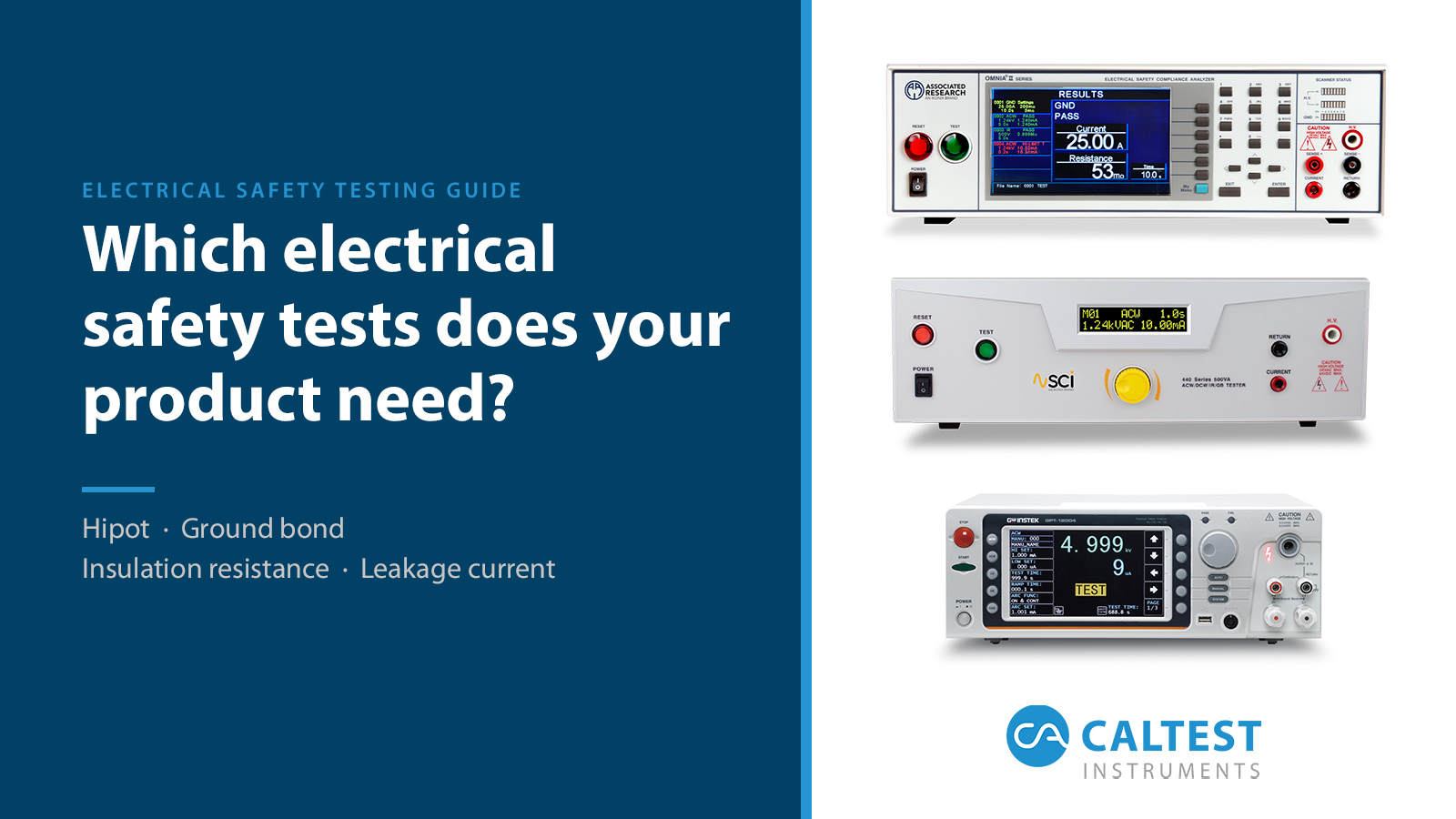
- Single-function or multi-function. A multi-function safety analyser runs hipot, ground bond, insulation resistance and, on some models, leakage current from one connection. The Associated Research OMNIA II covers all four. The GW Instek GPT-12000 and the SCI 440 Series cover hipot, insulation resistance and ground bond. A dedicated tester can suit a line that tests one thing at high volume.
- Test voltage. Most mains-powered products are tested within 5 kV AC or 6 kV DC, the range of the multi-function analysers. Cables, motors, components and switchgear can need more: the GW Instek GPT-15012 goes to 12 kV DC and the Associated Research HypotMAX to 20 kV. Your standard and your product's rated voltage set the figure.
- Ground bond current. Match the tester to the current your standard sets: 40 A on the OMNIA II, GCT-9040, HYAMP and SCI 440, and 60 A on the SCI 266.
- Bench or rack. Lab work suits a bench instrument with a clear display. Lines often want a rack unit with remote control: the OMNIA II has USB, RS-232, Ethernet and GPIB.
- Buy or rent. A type-test campaign or a production peak may not justify a purchase. Every line on our safety testers page can be rented as well as bought.
Our electrical safety testers page brings the Associated Research, GW Instek and SCI ranges together, with a hipot tester and a ground bond tester category for each test.
Not sure which tests apply?
Tell us what your product is and the standard you're working to, and we'll support you in choosing an appropriate test set-up. If you already have safety testers, tell us the model and we'll confirm how we can support its calibration.


